Technical guide
Primers: what they do, why PVA fails, and what to use on each substrate
A plain-language guide to priming: what cement-based products need in order to harden, what a dry substrate takes away from them, why PVA solved that problem and destroyed the bond doing it, how a modern primer actually works, and what belongs on each type of background.
By Mihail Cheptene · 22 August 2026
Cement does not dry. It reacts.
Every cement-based product needs three things: time, temperature and water. Hydration is a chemical reaction, not evaporation. Cement grains dissolve at the surface, crystals of new compounds grow out of solution, interlock, and bind everything into a single body. Around a quarter of the cement by weight is taken up as chemically bound water, with a further portion held physically in the gel pores. Any water beyond what hydration needs stays in the mix as capillary porosity, which is why the water content of the mix decides the final strength.
Around seventy per cent of the strength arrives within the first 28 days. After that the gain continues for decades, but as a very small percentage of the total. The reaction itself never ends: unreacted cement stays in the body of the material and keeps binding water a century later, provided the temperature is above 5 °C and the humidity inside the pores stays above roughly 80 per cent.

Hydration seen at the scale of the cement grains. The grains dissolve at their surfaces, crystals grow out of solution into the water between them, and the crystals interlock until the mass is a single body. The cores that remain unreacted are what keeps binding water for decades afterwards. Schematic, not to scale.
Where the water goes
A dry substrate pulls that water out by capillary action in the first minutes, and it pulls it from the layer closest to itself: the bond line. Pore humidity there falls below 80 per cent before the cement has built enough crystalline structure to carry any load.
This can happen with no voids at all. The material stays in contact with the substrate. What forms is an under-hydrated layer a fraction of a millimetre thick: the substance is present, the strength is not. In effect it is dust that was wetted once and dried again.
The defect does not announce itself. The tile stands, and where the layer is continuous the tap test at handover is clean, because there is no air beneath it. The weak plane sits inside and waits for load: a heating season, a swing in humidity, an impact. Debonding arrives years later and is identified only on removal, as grey powder on the back of the tile under a joint that still looks sound.
How it was solved before
This was always understood. Substrates were soaked as far as time allowed, and thin layers were deliberately avoided. A thick layer carries its own water in surplus: some goes into the substrate, and what remains is enough for hydration. That surplus also wetted the loose surface dust and took it up into the body of the mortar as it was pressed and worked in, instead of leaving it as a plane of separation. The thickness itself acted as a buffer between substrate and finish, absorbing the difference in their movement.
It broke when the layer became thin. A three to six millimetre notch, flow screeds, a slab instead of a 150 mm square. Soaking does not work underneath that: water is not retained in the pore, the surface is dry again within half an hour, the state between no longer pulling and standing in water cannot be judged by eye, and there is nothing in three millimetres to absorb the error.
What the technology needed was something that would limit the capillarity of the substrate itself and stay there after it dried.
PVA: the logic was right, the solution was not
Polyvinyl acetate was already on site as the binder in emulsion paint. It was diluted with water and tried. It suppressed capillarity: the dispersed particles are largely too big to travel into the pores, so most of the dispersion stays at the surface and closes over it as a film. The substrate drew far less water, and the under-hydrated layer disappeared, because the water in the adhesive had nowhere to go.
What disappeared with it was the bond.
A continuous film means closed pores, which means the adhesive cannot penetrate them, which means the mechanical key that carries everything is absent. The adhesive reaches full strength, but everything now hangs on a soft polymer layer between it and the substrate. This is the one place on site where the intuition runs backwards: PVA is usually laid on thick, on the assumption that more of it grips harder. A thin, well-diluted coat tears as it goes on and leaves some pores open, so a little key survives by accident. A generous coat covers without a break, closes every pore, and leaves more of the material that the alkali will later destroy. The thicker the PVA, the worse the outcome.
Worse, the film does not survive. Fresh cement sits at pH 12 to 13, and that alkalinity hydrolyses the acetate groups of polyvinyl acetate: the polymer softens and loses cohesion. So the situation degrades rather than holding steady. On day one the tile is at least held by an intact film; months later the intermediate layer is breaking down from the inside, and there is nothing left to hold anything. The break runs through that layer itself, not along an interface. In a wet area, plain lack of water resistance is added to the list: the film softens back and takes what remains with it.
The result is one cause of debonding traded for another. PVA closed the water problem perfectly, and in doing so destroyed the thing the water was needed for.
What a primer actually does
A primer alters a thin surface layer of the substrate itself, a fraction of a millimetre deep, and stays there for the life of the covering above it.
The polymer dispersion penetrates the surface pores, the carrier water leaves, and the polymer stays inside as a solid film on the capillary walls. The cross-section of the pore is reduced, and the rate of absorption falls with it. The substrate does not stop absorbing; it starts absorbing slowly, so the adhesive sets before pore humidity at the bond line drops below its working threshold.
It narrows, it does not seal, and that is exactly where PVA failed. Complete sealing removes the mechanical key along with the absorption, and the bond depends on adhesive penetrating the pores. The pore stays open, only narrower, so the adhesive still enters it — where PVA capped the mouth and left it nothing to enter. The same action binds the loose dust layer at the surface: it stops acting as a separator and becomes part of the substrate, while keeping the roughness the bond works on.
There is a temperature floor. The polymer particles have to deform and fuse into one another, and below the minimum film formation temperature they are too rigid to do it. The water evaporates, the surface looks dry, but no film forms and a powder without strength is left behind. Priming an unheated room in winter fails while appearing to have worked.
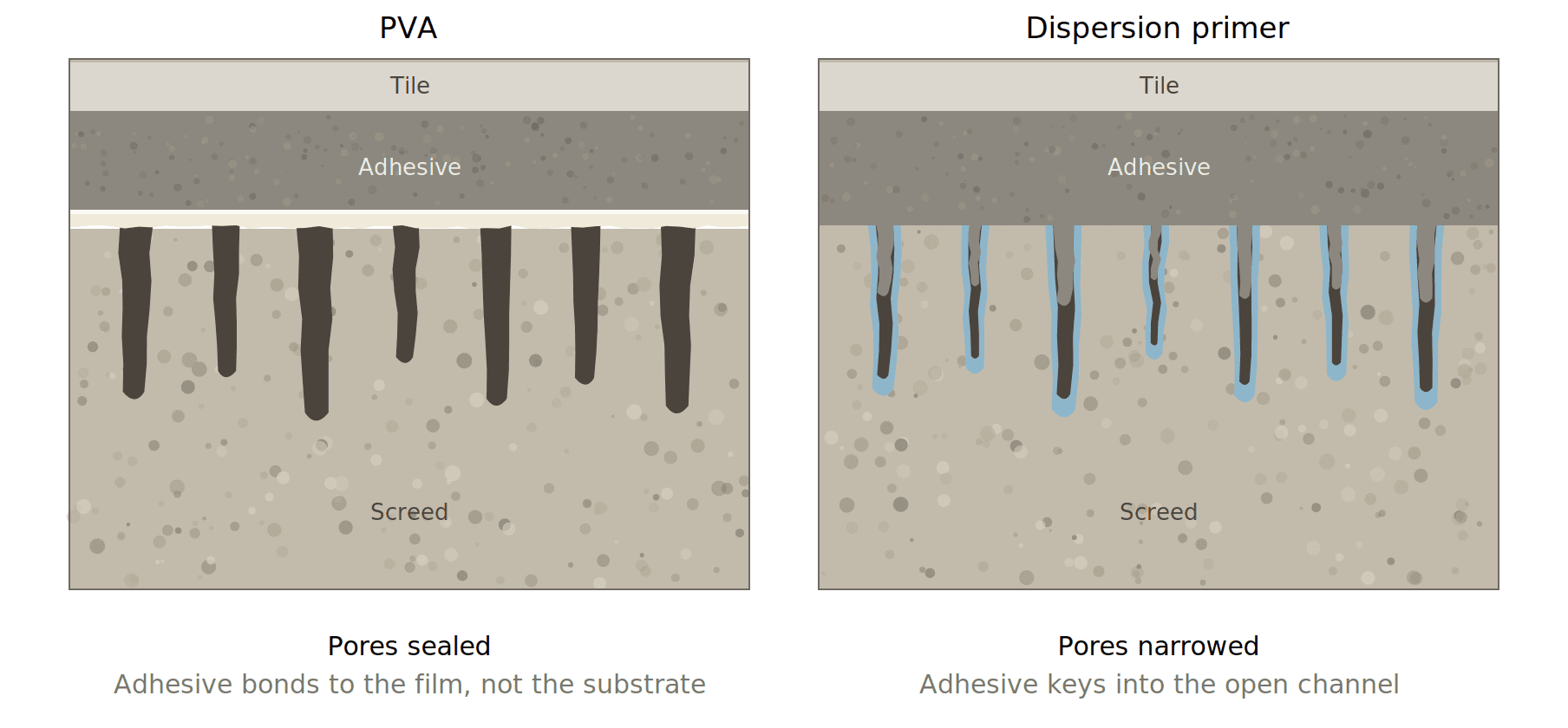
The same substrate under two treatments. PVA caps the pore mouths, so the adhesive bonds to the film rather than to the substrate. A dispersion primer coats the pore walls, narrowing the channel while leaving it open, and the adhesive keys into what remains. Schematic, not to scale: pores are measured in microns, the adhesive bed in millimetres.
Two branches of chemistry
By the 1980s the task was stated precisely: limit capillarity without killing the key. PVA had proved that a continuous film is not the answer. Chemistry offered two routes.
Dispersion primers are water-borne. The polymer, acrylic or styrene-butadiene latex, is already formed; the water only delivers it into the pore. The water leaves, the polymer stays as a solid film on the capillary wall, narrowing it without closing it. Once dry it does not redisperse in water and is not broken down by the alkalinity of cement.
Reactive primers are epoxy and polyurethane. The polymer forms in place: epoxy cures with a hardener, polyurethane with a second component or, in single-component products, with atmospheric moisture. Absorption is not narrowed but abolished, so the key has to be created from scratch, with quartz broadcast into the wet resin.
Dispersions became the default, and not because they are stronger. Reactive systems are objectively more capable: terrazzo, old adhesive residue, residual moisture, and anhydrite where the moisture reading is still high or the risk of ettringite has to be shut out entirely. But each demands mixing or pot-life control, costs several times more, forgives less, and afterwards the bond rests not on adhesive penetrating the substrate but on the quartz broadcast, which is there precisely to give the surface its roughness back. A sound, dry anhydrite screed is routinely primed with a dispersion where the adhesive manufacturer names one.
A dispersion turned out to be the only option that solves the original problem while going on with a roller in five minutes, diluting with water to suit the absorbency of the substrate, and introducing no new way to get it wrong. It covers not the hardest case but the most common one: an ordinary absorbent substrate under any thin layer, whether adhesive under a notch, a levelling compound or a thin render.
Reactive resins stayed where a dispersion has physically nothing to narrow, or where narrowing is not the problem: a non-porous substrate, a chemically hostile one, or a wet one.
What to prime with
Cement screed, concrete, cement render. A dispersion acrylic primer, diluted to suit absorbency. Dusty or strongly absorbent backgrounds take two coats, the second on the dried first. The job here is the standard one: bind the dust, slow the suction. What a primer will not do is restore strength: where the screed is friable, cracked or hollow beneath, that is a repair before it is a priming question, and is covered in the screed repair guide.
Anhydrite screed. Calcium sulfate and Portland cement are incompatible: in the presence of water, ettringite grows at the interface, a crystal that occupies more volume than the substances it came from, and it tears the bond apart from inside. Mechanical work comes first, the surface skin removed by sanding, otherwise the primer lands on a weak layer. Then a primer whose job is the separation of two chemistries rather than absorption control. Acrylic is acceptable here only where the adhesive manufacturer has named it for anhydrite; the reliable route is epoxy with a broadcast. Screed moisture is measured before starting, not judged by eye.
Gypsum plaster and plasterboard. The same incompatibility with cement, but under milder conditions: a wall, dry, light load. An acrylic primer named by the adhesive manufacturer for gypsum. SBR does not belong here, it is for floors and mortars. Separately: gypsum in a wet area is not a tiling substrate at all, and that calls for a board (wedi board guide), not a primer.
Existing tile, polished concrete, terrazzo, epoxy, metal. There are no pores, nothing to narrow, and a dispersion sits on top as a separating layer. Mechanical preparation comes first: degrease, sand off the glaze or create a profile. Then epoxy with quartz broadcast into the wet resin, so the key is rebuilt out of sand rather than out of the pores of the substrate.
Damp or young screed. A primer does not stop water, and a dispersion certainly does not. Where moisture is above what the adhesive allows and waiting is not an option, the answer is an epoxy damp-proof barrier in two coats with a broadcast. Substituting a primer for drying time is the most expensive mistake on this list, because it only surfaces after the tiles are down.
Old adhesive, paint residue, bitumen, oil. A primer does not isolate contamination. It comes off mechanically, back to the substrate; where removal is impossible, epoxy goes down, and that is a compromise rather than a solution.
Common questions, straight answers
Is PVA ever acceptable under tiling?
No. Under any cement-based product, whether adhesive, levelling compound or render, it should not be used, and the fact that it appears to work at handover is part of the problem rather than a defence of it. The Tile Association states this without qualification. BS 5385 requires a substrate fit for bonding, and adhesive manufacturers name PVA specifically as incompatible in their data sheets.
How do I recognise PVA on a substrate I have inherited?
A glossy, slightly tacky film that becomes tacky again when wetted and lifts in sheets when scratched. It has to come off mechanically, back to open pore. Priming over it places a second bond on the same failing plane. Where removal before starting is impossible, the condition of the substrate is recorded in writing beforehand.
Is a primer more expensive than PVA?
Usually not. A dispersion concentrate dilutes at 1:3 or 1:5 depending on absorbency, so the cost per square metre is no higher than PVA and often lower. Cost is not what keeps PVA on site.
Why do so many trades still use PVA if it fails?
Because the result is visible only on a strip-out. The first years look and sound correct: the tiles stand, the tap test at handover is clean, the money is paid. Debonding appears later, after three other trades, a change of occupant and a heating season. The complaint reaches whoever was on site last, so the feedback rarely returns to the person who caused it.
One coat or two?
Absorbency decides. A sound, moderately absorbent screed takes one coat at the dilution on the data sheet. A dusty or strongly absorbent background takes two, the second on the dried first, with the dilution adjusted rather than the number of coats guessed. What matters is that the primer penetrates rather than pools: a glossy surface after drying means it stayed on top.
Does priming replace drying time?
No. A dispersion primer regulates absorption; it is not a moisture barrier. Where residual moisture is above the limit set for the adhesive, either the screed dries or an epoxy damp-proof barrier goes down. A primer chosen for suction control does not close that gap.
We are stripping out old tiles. What should the substrate check include?
Assume PVA until proved otherwise: on refurbishment work it is what turns up most often, because it was standard practice for decades. The test is water. Wet a patch and watch it: a sound open surface darkens and absorbs within a minute, whereas a film goes slick and tacky and the water sits on top. Removal is mechanical. Scraping and a diamond cup wheel with dust extraction on walls, a grinder or scarifier on floors; hot water softens the film first and makes scraping faster, since it re-emulsifies. Solvents are not the route. Repeat the water test afterwards to confirm the pore is open, then prime with the product named in the data sheet of the adhesive being used.
Can new tiles go straight onto the substrate the old ones came off?
Start with how they came off, because that is already information. Tiles that lift whole with little effort mean the bond had largely failed before anyone touched them, and on refurbishment work PVA is the first thing to suspect: a glossy skin left on the substrate or on the back of the adhesive confirms it. Grey powder instead points to an unprimed background — dust, suction, or both; the mechanism differs but the remedy does not. Either way the old layer comes off before anything new goes on. Beyond that, a strip-out takes part of the background with it: gypsum plaster usually comes away in patches with the tiles, and screeds are left gouged and ridged with old adhesive. What matters is not how clean it looks but whether it is sound and flat, checked with a straightedge rather than by eye. There is also a suction problem that is easy to miss. Old cementitious adhesive left in place is dense and barely absorbent, while the screed exposed beside it is wide open, so one floor now has two different rates of suction. A primer narrows pores; it cannot equalise a surface that is half sealed and half raw. The usual answer is to take the residue off entirely and re-level, treat the result as one substrate, and prime that — the repair itself is covered in the screed repair guide. In a wet area, any tanking disturbed during removal is replaced, not patched.
Based on BS 5385 Parts 1, 3 and 4, guidance published by The Tile Association (tiles.org.uk), and the technical data sheets of cement-based adhesive manufacturers. Primer selection is part of the adhesive system, not a separate purchase: where a manufacturer names a primer for a given substrate, that naming has the last word.